AnchorCam Stereo
Stereo, IMU, mic, radios. One board, your firmware, $240.
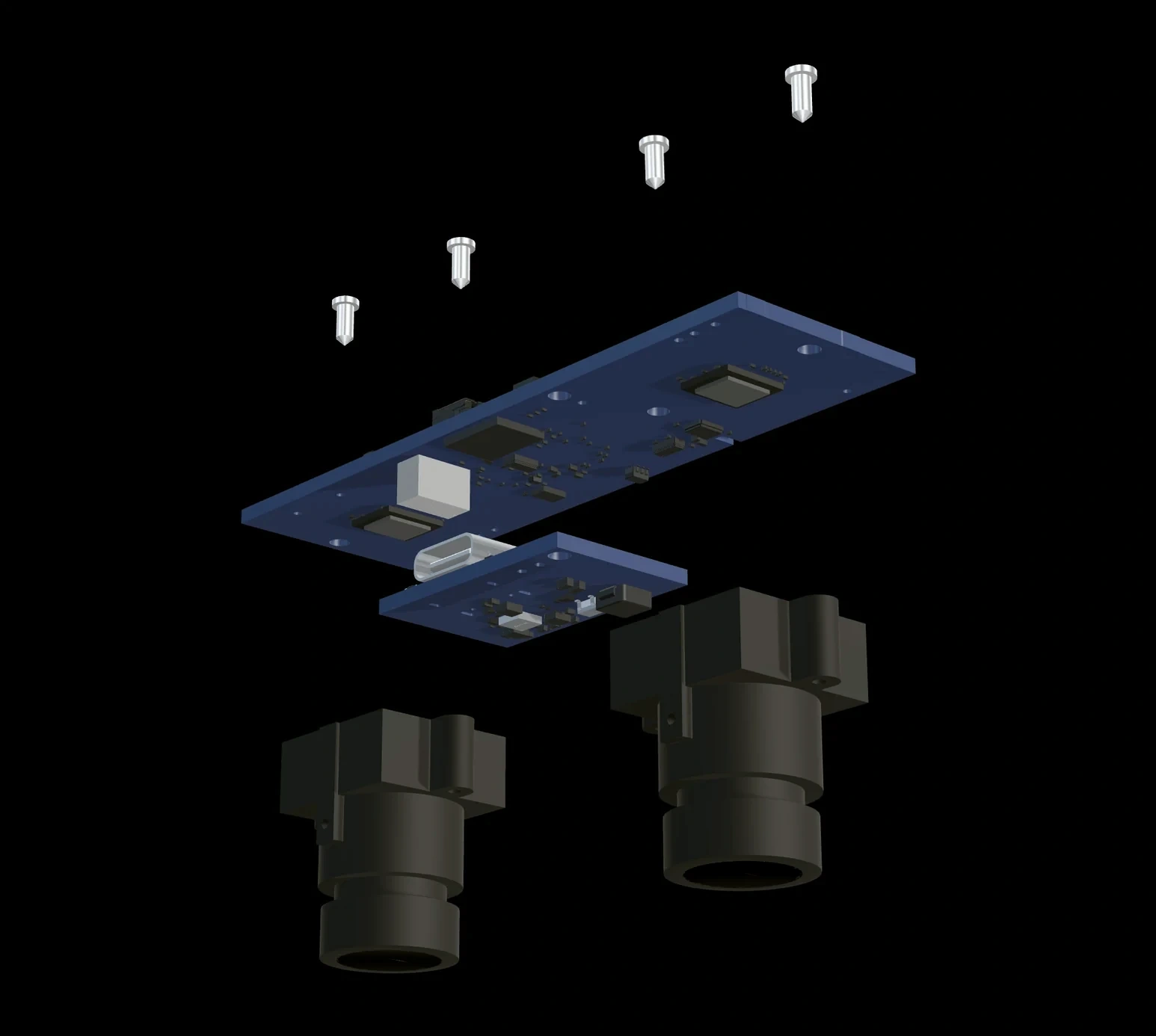
Two sensors on one exposure line, with an IMU and a mic beside them, on one 23 × 74.5 mm board. The camera you collect with and the camera the robot carries are the same part, so training and inference see the same sensor and the same optics.
What it is
The camera is the machine. It sees, it computes, it stores, it transmits, with no host and no trigger box. The microphone is on there because a connector clicks when it seats, and the sound confirms the insertion before the image does.
Status. In development. Renders reflect the current design, and board revisions are ongoing. Imaging. Two onsemi AR0234CS global-shutter sensors provide 1920 × 1200 (2.3 MP) per camera with a 1/2.6-in optical format. Dual-camera frame-rate modes and lens-specific fields of view are under system characterization for this sensor. Footage on this page predates the sensor change and is not a Rev 6 performance specification. The 23.28 × 74.54 × 29.34 mm envelope is measured off the board assembly; the enclosure is the vendor's concept model and is not final. The next board revision. The baseline goes from 50 mm to 70 mm, a magnetometer joins the IMU for 9-axis motion sensing, and the radio moves to an ESP32-C5 for dual-band Wi-Fi on a pre-certified module, so radio approval carries rather than being re-tested on the assembly. Ultra-wideband arrives in the same revision. None of that is on the current board, and external camera clock distribution is design rather than shipped hardware. Prices are targets against the current BOM and tariff; quantity and lead time are open.
Download the full spec sheet (PDF) Issued 2026-08-22 · Rev 6 · Preliminary.
How it's built
Get one
Price
Hardware-synchronized stereo is not news; two industrial cameras and a trigger box have done it for years. What does not exist is all of it on one 23 × 74 mm board, at $240 a unit. Fifty rigs of that arrangement is two hundred objects: a hundred cameras, fifty trigger boxes, fifty computers. Rigs that move independently cannot share a host machine. Fifty of this one is fifty cameras.
FIRST 100
Pre-order open
$180 a unit for the first 100. Paid now, refundable in full on request any time before shipping. The design is not frozen, so requirements raised in this window shape the early units.
NEXT 500
Second batch
Once the first hundred are taken, orders roll into the next 500 at $210 a unit on the same terms.
Opens when the first 100 are taken
Standard
$240 a unit, the price once the pre-order tiers are gone. The M12 lens module is interchangeable, so the optics choice stays yours.
Opens when the pre-order tiers are gone
Fleet
From twenty units we quote. Quantity, lead time, lens configuration and invoicing terms get settled together. Orders above 100 units come here rather than through a payment link.
LPDDR4 has risen roughly sevenfold in a year, and anything built on a Linux single-board computer with gigabytes of it has risen with it. This board carries 256 MB of DDR3L inside the SoC package, so that rise has not reached the price.
Design partner program
This fall: our first robotics design partners.
Sign up by August 20 for accelerated lead times. The program is for robotics and data-collection teams whose next problem is the count: the rig is settled, and it now has to exist in quantity. A design partner specifies the device rather than orders one, because nothing about it is frozen yet.
Design partners get remote firmware flashing. Put your own build on a unit without shipping it anywhere, with UART output and remote boot and reset, so a unit can always be brought back.
Remote access is down right now. The prototype broke during bring-up and the next batch is on order. The sign-up stays open, and we come back to you in order the moment access is up.
Who's behind it
Traction
Grepp MOU
MOU with Grepp (Programmers) for AI-powered online exam proctoring.
AttentionX Cohort VII
Accepted to Korea's leading AI startup accelerator program.
Founders Inc
Joined the Fort Mason founder community for hard-tech and AI builders.
NVIDIA Inception
Member of NVIDIA's program for AI and robotics startups.
Team & backing

Yejun Jang
Co-founder / CEO · AI & Security
Seoul National University (SNU)

Alex Jihoon Park
Co-founder · PCB/HW
MSc Physics, King's College London

Kihyun Kim
SW/Firmware · Joined July
MEng EEE, Imperial College London
* Some team photos have been lightly edited with AI. Faces are real.
Kay Kyungsik Woo
Founder/CEO of MVL Labs. Runs TADA: 2M+ users, 200K+ drivers, $40M+ raised, ~250 employees globally.
Incorporated April 2026. 7 patent applications filed in Korea, two of them extended internationally under the PCT in August 2026. Capture-time signing is a separate line of work, and there is more on it here.
Lately
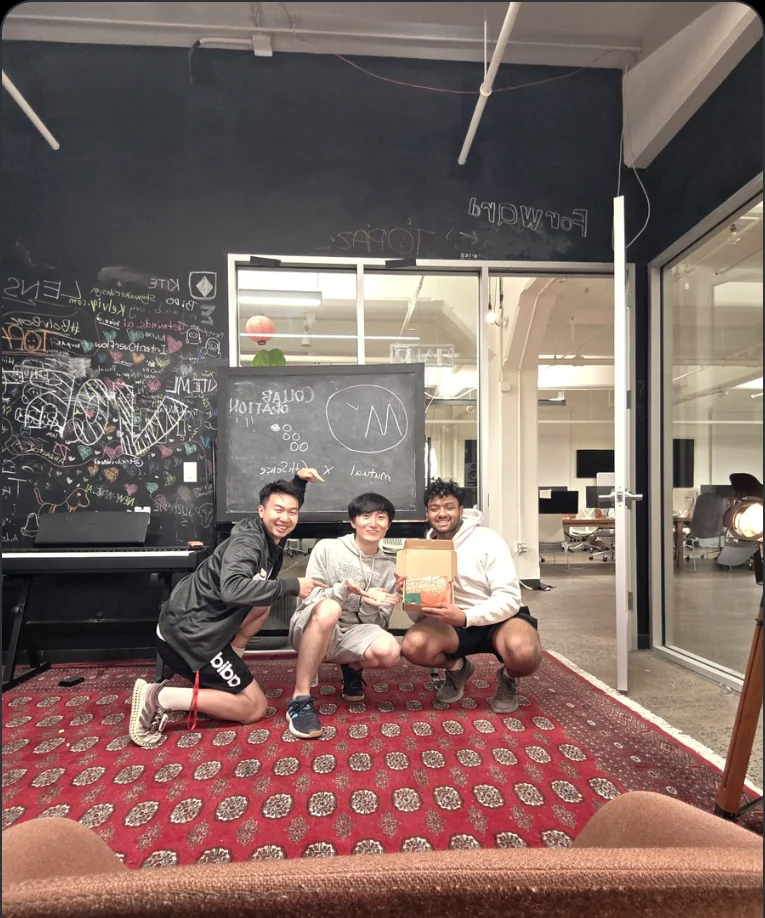
First sale. After 7 months of building. We finally got to experience it. We look forward to collaborating with @ronakgt from 6thsense.
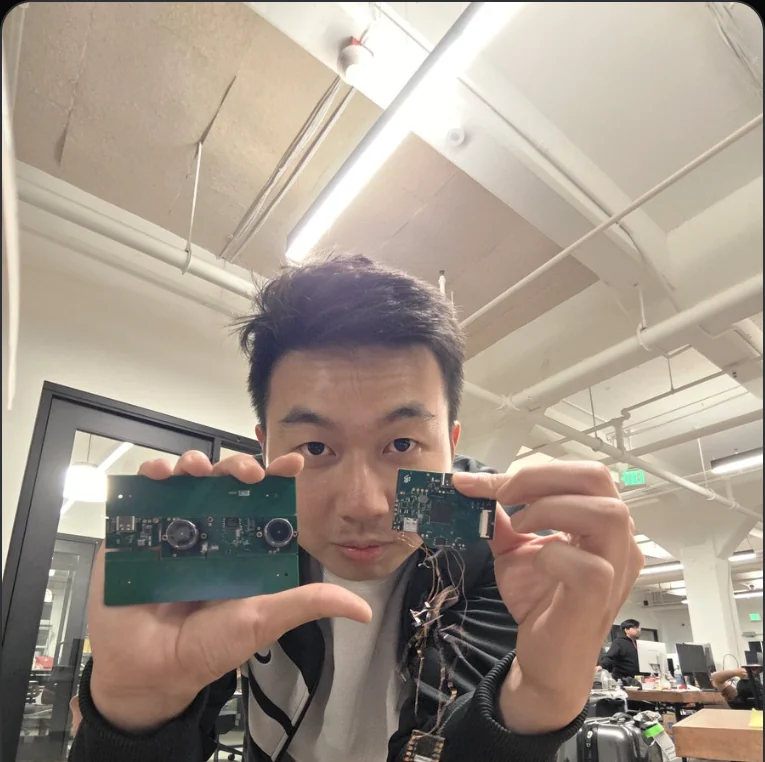
Have come so far from building development prototype to our own stereocamera.
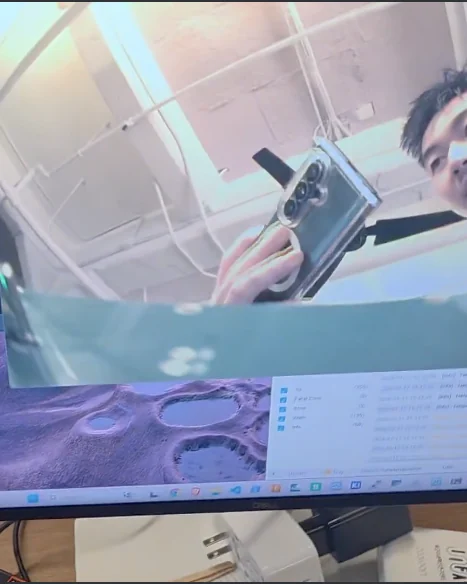
Got my full custom camera sensor to software stack working!!!!
Posted while the boards were being built. Each links to the original.
The sensor no longer documents reality. It learns to reproduce it.
Same camera at training and deployment = no distribution shift. The model doesn't collapse because the robot's optics differ from the collection ones.
Impressive pack-sensor stack, NPU, wireless, all under $240. Solid move for egocentric rigs.
Written by other people after the 8 August announcement, not by us.

Not a fit for the program? Get in touch anyway.
Last updated 16 August 2026 · mutual.solutions